
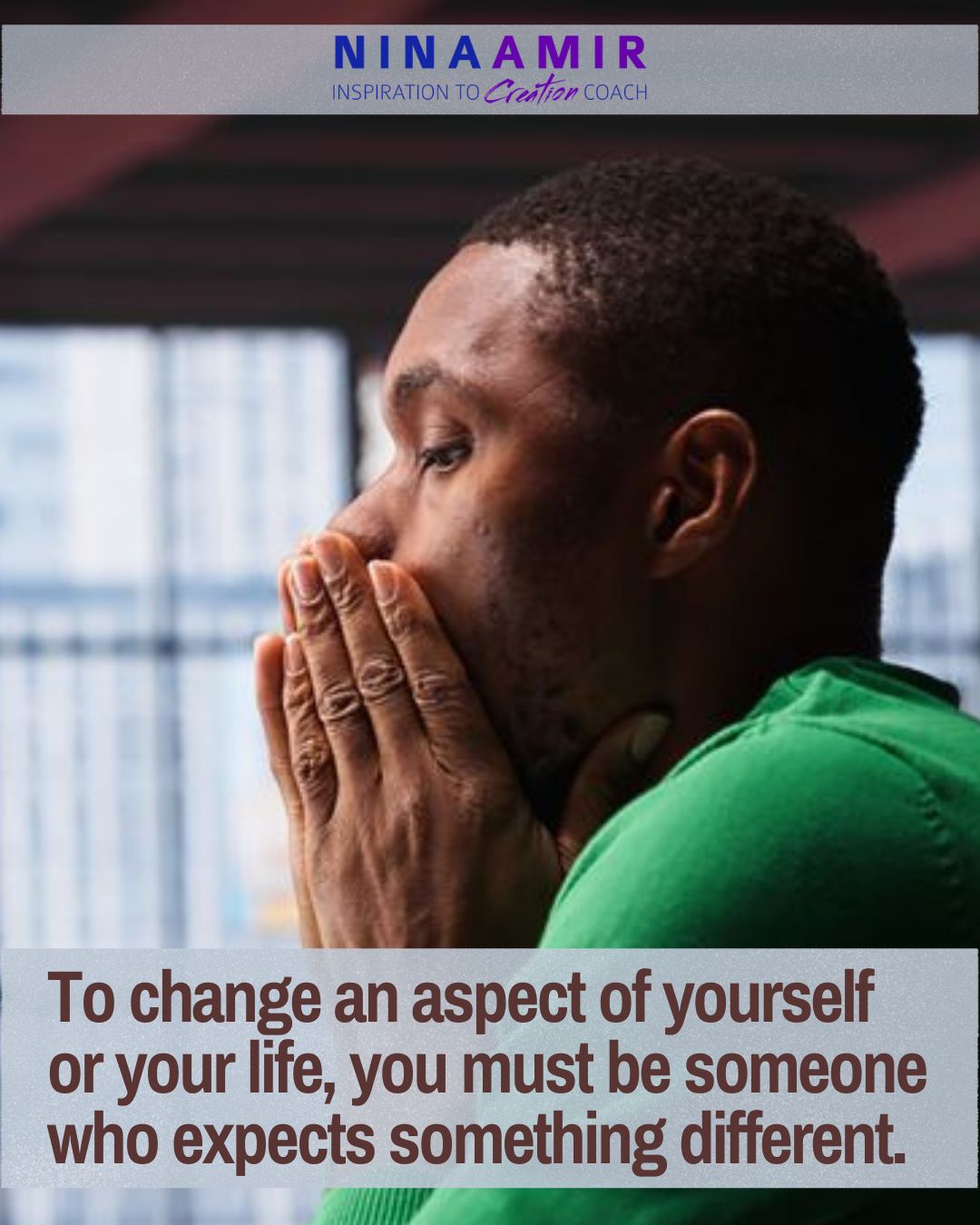
You’ve been trying to change your life, but you can’t seem to change your habits or mindset. So, you keep having the same experiences and results. Here’s why: nothing will change until you change your expectations.
As long as you believe your future will be like your past, it will be. You’ll keep getting what you expect.
Your Brain Expects the Past to Reoccur
Neuropsychology offers an interesting look at how expectations impact your outcomes. Neuropsychology, a scientific and clinical branch of psychology, studies how the brain’s structure and function relate to human behavior, thinking, and emotions. Neuropsychologists have found that the brain uses past experiences, beliefs, and expectations to predict what you experience next. These predictions influence what you notice, how you interpret events, and how you respond to opportunities.
A prediction is a formal, objective statement or estimate of a future event based on data, analysis, or scientific reasoning. Weather forecasts provide good examples of predictions. Just as a weather person predicts whether it will rain based on past weather patterns, your brain uses past experiences to predict future outcomes.
Let’s say you went bankrupt before. Now, you want to start a new entrepreneurial venture, and your brain predicts that you will go bankrupt again.
When you add your human nature and identity to the equation, you develop expectations. These are personal, subjective beliefs or assumptions that something is likely to happen based on past experience.
Beliefs are formed by repetitive thoughts. If you repeatedly think you will go bankrupt again, you develop the belief that it will happen. That belief becomes an expectation of that outcome.
Going bankrupt felt like a huge, traumatic failure to you. Despite your desire to succeed with your new business, you fear you could fail. You often focus on that unwanted outcome. Although you may not admit it, you expect to go bankrupt again, and your subconscious mind supports that expectation.
Your brain, specifically the reptilian part, will remind you of this possibility as if it were a data-based prediction. Its job is to keep you safe, so your mental chatter revolves around your past bankruptcy and the danger this new venture represents. To influence your decision, it will tell you you could fail again, and that could harm you in many ways.
Create a New Reality with New Expectations
Trying to create a new reality while subconsciously or consciously expecting your old reality to continue is a broken strategy. You can’t create something new by expecting the past to repeat itself.
To change your life, you must intentionally expect a different one. And to do that, you must decide to be someone with different expectations.
You become someone who has a different belief about the future. The more you focus on that new expectation, the faster you retrain your brain to support a new outcome.
Neuroscience shows that the brain has neuroplasticity, the ability to reorganize itself by forming and strengthening new neural connections. This means the thoughts you repeat, the beliefs you reinforce, and the actions you take consistently shape how your brain responds to the world. By repeatedly practicing a new way of thinking or behaving, you create and gradually strengthen those new patterns and weaken the influence of old, unhelpful ones.
You cannot create a new life while continually expecting the old one to exist. But you can train your brain to expect the life you desire. And you change your beliefs about the future by becoming someone who expects to create the life you desire.
I Expected Men to Leave Me
Until you change your identity, you’ll keep struggling to change any other part of your life. You and your life will stay the same until you become someone who expects something different.
When you choose a new identity, your mindset and habits align with who you are being. So, when you become someone who expects a different life, your thoughts revolve around that possibility and your actions support creating it.
Your new thoughts create new beliefs about the future. Thus, you develop new expectations.
My father died when I was only seven, an event I interpreted as him “leaving” me. I believed all men “leave.” I became a woman who expected my relationships with men to end when they left…not when I left. And they did.
With the help of a therapist, I realized that my father hadn’t left. That was just a belief a seven-year-old girl formed in her subconscious mind.
Realizing the truth, I gave up the identity that I was a woman men leave and the corresponding expectation that men would leave me.
When my identity shifted, I dropped the beliefs and behaviors that drove men away.
I no longer had a data point to base my prediction on. I was free to expect something new.
At that point, I met my husband. We’ve been married 38 years. Despite some issues we’ve faced in our relationship, he has never wanted to leave me—even though I sometimes thought he should.
How Subconscious Beliefs Shape Your Expectations
Your beliefs influence how you interpret your experiences and what you expect in the future—even if you aren’t aware of them.
For instance, if you subconsciously believe you aren’t good enough, you might hesitate to share your ideas, avoid new opportunities, or assume other people are more qualified than you. You expect results that confirm you aren’t good enough.
When someone criticizes your work, you see it as confirmation that your belief is correct. When someone praises you, you dismiss the compliment because it is misaligned with your belief about yourself.
Your belief is about what you expect: “I believe I am not good enough. Thus, I expect my efforts to fall short or to be seen as deficient (for the job, relationship, or opportunity).”
Your subconscious mind has learned what to expect, and you keep responding in ways that reinforce that expectation across all areas of life. In fact, your neurological pathways take you down this same line of thinking every time.
You might consciously want a loving relationship while subconsciously expect rejection. You could want financial abundance but believe you never have enough money. Or you may want to share your gifts with the world while expecting to fail or be criticized, judged, or rejected.
Until you become aware of these expectations, your conscious and subconscious beliefs will continue influencing your choices—and results—without your permission.
How Your Brain Predicts What You Will Experience
Researchers describe the brain’s use of expectations to interpret incoming information as predictive processing. Your brain draws on previous experiences to anticipate what might happen and adjusts its predictions when new information challenges them.
This ability helps you navigate the world. But it also keeps you stuck in familiar patterns.
If you expect rejection, you may interpret an ambiguous response as just that. If you expect failure, you may focus on obstacles rather than possibilities or small successes.
Of course, you can expect money to flow to you easily; therefore, it does. You might expect people to be nice to you, and so they are.
Your expectations influence what you notice, experience, and believe about your experiences.
How to Change Your Expectations and Your Life
If past experiences shape your expectations, you can train your brain to expect something different by letting it learn from new experiences.
Here are three ways to begin that process.
1. Become conscious of your existing expectations.
Pay attention to your habitual thoughts. Notice the assumptions you make about yourself and your future.
When you catch yourself thinking, “This type of thing never works out for me,” question that expectation.
Is it always true? Or are you using past experiences to predict what will happen next?
Start expecting something different. Search for past data points that support a new prediction.
2. Imagine a different future.
Creative visualization lets you imagine possibilities beyond your personal history. Instead of repeatedly picturing what has gone wrong, imagine yourself experiencing the results you want. Imagine how you would think and act if you expected the outcomes you want to be possible.
See yourself being a person who achieves the results you desire…and expects them with 100 percent certainty. What would such a person think and do?
3. Adopt an identity that expects something different.
Decide to be the person you imagined…the one who achieves the outcomes you desire. Choose that identity.
In the last step, you already imagined the mindset and habits such a person would have. Now, adopt and demonstrate them. Specifically, take on the beliefs and expectations such a person has about their ability to create what they want.
This is easier to accomplish than you think. As soon as you adopt that new identity, your habits and mindset change. That makes it possible to have new expectations—and to get different outcomes.
For example, if you currently identify as someone who struggles, you expect struggle. When you choose to be someone who goes through life with ease, you expect to experience ease. You will also act as if things are easy—and experience them that way—and assume things will go smoothly.
Ask yourself, “Who would I be if I expected my desired future to be possible?” Then be that person, and expect that future.
4. Take action that supports your new beliefs.
Now, as a person who expects your life to change, give yourself opportunities to create the life you desire.
If you want to believe you are capable, do things that prove your ability. Or if you want to believe you can succeed, take steps toward your goals.
Take action while expecting change. Each new experience gives your brain new data points to make new predictions. At the same time, you train your brain to expect something different.
You are now being someone who expects and creates change.
Create a New Reality by Expecting Something Different
Changing your life isn’t simply about doing different things. In fact, trying to do things differently rarely works unless you change who you are being—your identity. That’s when you change the beliefs and expectations that influence what you do.
The life you desire requires you to stop expecting history to repeat itself. Be someone who expects to experience the life you want. That’s when change happens.
Are your expectations preventing you from creating the life you want? Tell me in a comment below. Please share this post with those who may benefit from reading it.
Coming Soon!