
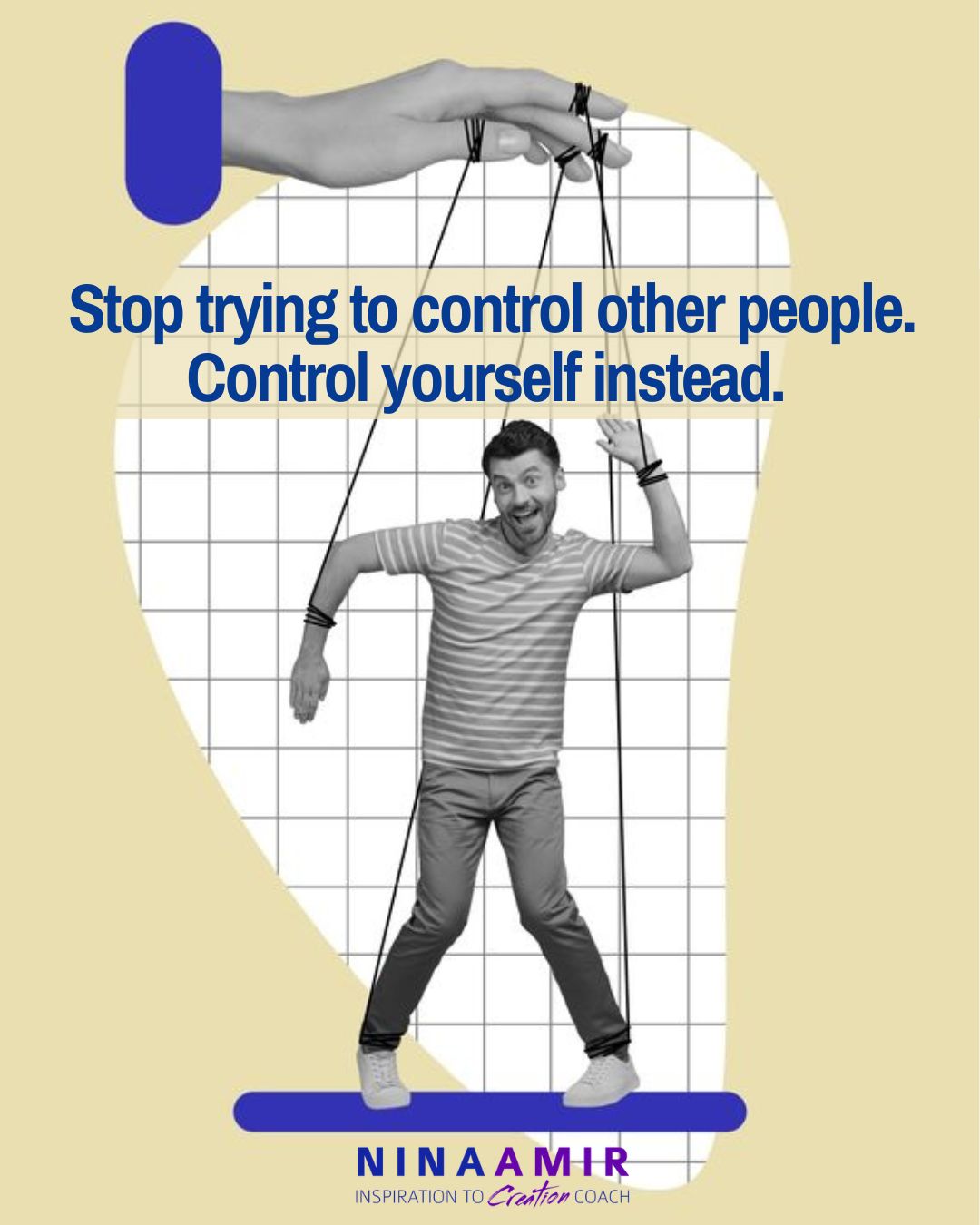
It’s impossible to force people to do things differently or to be different. They change only when they decide they want to change, not because you want or insist that they do. If you haven’t realized that by now, you are in for constant battles, disharmonious relationships, and loads of frustration and anger.
Believe me. I know.
I spent years trying to control my stepchildren and then my children. I wanted them to behave in the manner I deemed acceptable or desirable. I tried to control my husband. I wanted him to behave in a way I thought would be more aligned with who I wanted him to be and in a way that would help our marriage.
All to no avail.
My control efforts didn’t result in anyone changing. Instead, I became increasingly miserable, frustrated, and angry. (As an aside, anger is an attempt to control people, sometimes through fear.)
The One Person You Can Control
Maybe you want a spouse to be more considerate, your child to dress differently, a coworker to communicate better, a family member to stop criticizing you, your friend to call rather than text you, or a stranger to simply be kinder. You aren’t alone. Most of us spend an enormous amount of emotional and mental energy trying to get people to think, behave, or treat us differently.
But here’s a fact that can be both frustrating and incredibly freeing: The only person you will ever truly control is yourself.
You cannot control another person’s opinions, moods, choices, personality, or behavior. You can’t make someone understand or appreciate you, or act toward you in a manner you desire. You cannot control them in any way. (Well, to some extent you can control your kids, I suppose, but not for long.)
And knowing that can prove enormously frustrating.
What you can control is who you choose to be in response to other people.
Stop trying to control other people, and control yourself instead.
When you know and do that, you discover freedom, happiness, and inner peace.
Don’t Control—Just “Let Them”
If you can’t control anyone but yourself, there is only one way to respond to people who aren’t being or behaving the way you wish they would.
Let them.
Author and speaker Mel Robbins wrote about this in her bestselling book, The Let Them Theory. I can’t think of better advice than what she offered.
Let those people be who they are, behave as they like, do what they want, say what they say…no matter how much you wish they wouldn’t.
If they want to misunderstand you…let them. Don’t try to explain yourself so they understand.
If they choose not to support you…let them. Don’t attempt to get them to be your biggest cheerleader.
If they gossip…let them. Don’t call them out for gossiping or go complain about them to your friends.
If they don’t invite you…let them. Don’t bitch and moan to your friends or family or call them up and share how hurt you are by their oversight.
This is what not controlling people looks like.
Let them.
However, this approach doesn’t include approving of harmful behavior or allowing people to mistreat you. It does include recognizing that other people’s choices belong to them, and you can’t make them choose differently.
Know that other people’s actions have little to do with you and everything to do with them. Their behavior reveals their priorities, values, and level of awareness.
Remember that, and stop trying to control everyone. Then notice how much more emotional and mental energy you possess. When you stop controlling, you stop giving all that energy away.
And notice how much happier you are.
Your Opportunity to Change
Every person you encounter presents you with an opportunity to take control of yourself—not them. If you tend to be controlling in nature—someone who wants to control other people’s behavior—see each relationship as a chance to choose to be the opposite. Decide to be someone who is allowing, trusting, permissive, supportive, empowering, collaborative, or whatever word you believe describes someone who doesn’t attempt to control others.
Do not see encounters as opportunities to fix people. Also, don’t see them as a chance to convince someone to be different.
Instead, see every encounter—even with the check-out person at the grocery store—as an opportunity to practice becoming the person you want to be—someone who does not try to control others.
And remember, you can’t control anyone anyway. You can’t control someone who:
- Cuts you off in traffic.
- Criticizes your work.
- Dismisses your feelings.
- Gossips about you.
- Disappoints you.
- Ghosts you.
- Gets angry at you.
What you can control is who you are being in that moment. Do you choose to be someone who becomes angry, resentful, defensive, and reactive? Or will you choose to be someone who demonstrates patience, compassion, wisdom, and peace?
Other people’s behavior may trigger your emotions, but it does not have to determine who you are being in those situations. Your response determines that, and you get to choose your response.
You can choose to let them.
The Difference Between Reacting and Responding
Most of us spend much of our lives reacting. A reaction is automatic and originates from habit, fear, ego, programming, or emotion. Reactions happen quickly because they come from your conditioned patterns rather than conscious choices.

A response is different. A response includes a pause, even if only a few seconds, that creates space between what happened and what you decide to do next. In fact, a response is a choice about who to be or how to act in a given situation.
You don’t react. You pause, then decide how to respond—and who to be in that moment. Instead of reacting from emotion, you respond from intention.
That doesn’t mean you don’t have feelings. Indeed, you might feel angry, hurt, or disappointed. However, you don’t let your emotions dictate your actions—especially actions meant to control others.
Detachment Isn’t Indifference
Some might call this approach detachment, and it is. You detach from who people are being and what they are doing.
You can be detached and still care. And you care about yourself enough to take responsibility for yourself—not for someone else.
I know it can feel uncaring to detach and let them…especially when they are your children or other loved ones, for example. But you can care deeply about someone without trying to control them. In fact, the most loving thing you can do might be to accept that their choices are their own. Keep in mind that you can offer advice without becoming attached to whether it’s followed.
When you detach, you accept that you can’t control someone else. You can only control your response to that person.
Stop Being a Controlling Person
Ultimately, you can stop trying to control people with one personal change. Transform yourself from a person who tries to control people to a person who allows others to be who they want to be and do what they want to do.
Choose to be allowing rather than controlling.
That’s an identity shift…one that changes who you are and how you feel about others. It’s a shift that lets you find inner peace no matter what others do or say.
For a while, you will need to repeatedly choose not to try to control. You’ll have to fight down your frustration, anger, and desire—need—to make others do it “your way.” After a while, choosing to “let them” will become easier. And at a certain point, allowing others will become your habit.
And that habit leads to inner calm, rather than inner suffering. No more constantly thinking about how others are behaving. No more criticizing what people are doing. Instead, you allow them…let them, and you feel peaceful.
See each moment when you feel the overwhelming desire to control someone as a new opportunity to choose to be an accepting person. Know it is a chance to be someone who responds, rather than reacts, and it is a choice to feel more inner peace. Each time you take responsibility for who you are being, you become someone different—someone who no longer tries to control others.
Are you tired of the frustration that comes from trying to control people? Tell me in a comment below. Please share this post with those who may benefit from reading it.
Image courtesy of oneinchpunch.