Americans celebrated the Thanksgiving holiday this past week. For many people, this day revolves around cooking a huge turkey dinner and eating it with friends and family; it has no deep meaning. For others, the holiday is a time of reflection and a chance to express gratitude to those they love and appreciate—and even to God.
Unfortunately, too many people only think about gratitude on this one specific day…or never voice gratitude throughout the year. Some only remember to say “thank you” at times when something extraordinary happens, like getting a surprise promotion, surviving a serious car accident, or being cured of a deadly disease.
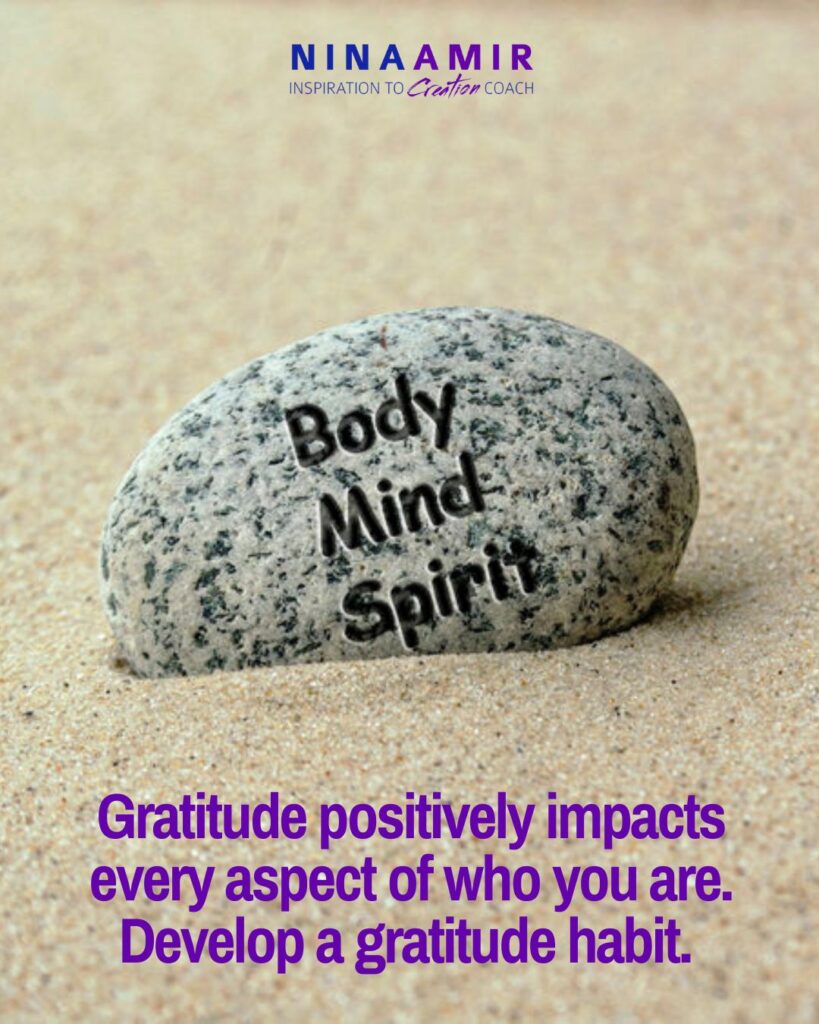
That’s a shame, since gratitude is such a powerful experience to have and share. In fact, feeling, focusing on, and expressing gratitude has a powerful impact on your mind, body, and spirit. And that’s a great reason to develop a gratitude practice.
Let’s take a look at how gratitude impacts you psychologically, physically, and spiritually.
The Psychological Impact of Gratitude
You can choose from a wide range of mindset practices. However, practicing gratitude offers some of the strongest psychological benefits. Here are a few:
1. Gratitude increases happiness and positive emotion.
Gratitude activates the brain’s reward circuitry, which increases the body’s production of dopamine and serotonin. These hormones make you feel good. Thus, you want to repeat the process and be rewarded again for feeling grateful, which develops a gratitude habit.
Additionally, gratitude shifts your attention away from what’s wrong or missing to what’s working and good. That change in mindset gives you a positive perspective on life, which makes you happier.
2. Gratitude reduces anxiety and depression.
Studies show gratitude practices, such as journaling or writing thank-you letters, significantly reduce depression symptoms. That’s why experts often recommend people write down three to five things they are grateful for each morning or evening (or both).
Gratitude also interrupts rumination—the repetitive negative thought loops that fuel anxiety. It’s impossible to think about things you fear when you are thinking about things for which you are thankful.
3. Gratitude raises resilience.
Focusing on blessings rather than problems strengthens your capacity to bounce back from challenges. Gratitude also puts difficulties in context. The adage about making lemonade out of lemons offers a great example of such resiliency.
4. Gratitude improves self-esteem.
Gratitude helps you appreciate your own strengths and the support system around you. As a result, you feel better about yourself. When you raise your self-esteem level, you find more things to feel thankful for about yourself.
5. Gratitude changes the brain.
Gratitude strengthens neural pathways for positivity. The more you practice gratitude, the more your brain automatically starts scanning for what’s good. It tries to go down the positivity pathway as often as possible, helping you develop a habit of gratitude.
6. Gratitude regulates the stress response.
Gratitude activates the parasympathetic nervous system (“rest and digest”), reducing cortisol levels caused by stress and fear (“fight or flight”).
Feeling grateful also calms the amygdala, the brain’s threat detector. Feeling grateful helps you experience less fear and anxiety because you hear less negative mental chatter.
7. Gratitude enhances cognitive functioning.
People who regularly practice gratitude experience improved concentration, creativity, and mental clarity. Their cognitive function gets better as they practice gratitude.
The Physiological Impact of Gratitude
The effects of regularly expressing gratitude are literally reflected in your physical state. This provides a strong health-related reason to feel thankful more often.
1. Gratitude strengthens the immune system.
When you feel and express gratitude, your body produces fewer stress hormones. Lower amounts of stress hormones in your body result in a stronger immune system. In general, positive emotion supports disease resistance.
2. Gratitude improves sleep.
If you struggle to fall asleep or sleep soundly, consider a nightly gratitude practice. Focusing on gratitude before bed can quiet your negative mental chatter, making it easier to fall asleep. Feeling grateful also improves sleep quality and duration.
3. Gratitude reduces inflammation.
Studies show that reducing stress also reduces inflammation, which is linked to many chronic illnesses. Focusing on what you appreciate and feel thankful for reduces stress; thus, gratitude provides one of the best ways to reduce inflammation in your body and improve your health.
4. Gratitude lowers blood pressure.
Feeling anxious or stressed raises the body’s blood pressure, which can cause damage to the heart and increase the risk of strokes and heart attacks. However, feeling grateful lowers blood pressure. Therefore, gratitude is a heart-healthy physical and emotional state that you can employ when something causes your blood pressure to rise.
4. Gratitude encourages a healthier lifestyle.
People who practice gratitude tend to have other healthy habits as well. Their positive outlook helps them exercise more, eat a better diet, and seek support when needed.
The Spiritual Impact of Gratitude
Gratitude is central to almost every spiritual tradition for good reason—it opens inner doors to an awareness and experience of “something more” than life on Earth. Additionally, it’s been said that gratitude is the most powerful prayer you can offer.
1. Gratitude increases your connection to “something bigger.”
Gratitude helps you recognize and feel supported by Life, the Universe, God, Source, or whatever you believe in. The more grateful you feel, the more you experience and believe that something bigger than you—something outside the human realm—has your back or is at play in your life.
Plus, the more thankful you become, the more able you are to find meaning and purpose in life. Even life’s challenging times become meaningful and something for which you can feel gratitude.
2. Gratitude expands consciousness.
When you learn to consistently find reasons for gratitude, your awareness expands to the miraculous nature of all things. You feel tapped into “something more”—or your spiritual nature.
Additionally, gratitude shifts your consciousness to what is good and working in your life. For example, you move your awareness from lack to abundance and become aware of all that is good in your life and the world.
2. Gratitude places you in the present.
You can only feel an emotion in the present moment. Experiencing gratitude, therefore, places you firmly in the present moment. Even if you feel grateful about the past or the future, you feel thankful now for what came before and what is still to come.
3. Gratitude enhances intuition.
When you’re “in gratitude,” you create a spiritually receptive state. Your inner guidance becomes clearer when you are open to receiving it. You might even feel grateful for the spiritual guidance you will experience, thus inviting it into your awareness.
4. Gratitude deepens compassion and empathy.
Genuine gratitude naturally extends outward toward others. You notice (become conscious of) how you’re supported by the people in your life—or Source, God, Creator, or The Universe—and how much good is in your life. This deepens your ability to notice, feel, or understand other people’s need for support and positive experiences. You become more compassionate and empathetic as you become more grateful, leading to a greater desire to support or give to others.
5. Gratitude aligns you with spiritual states.
So-called “spiritual people” tend to feel and express gratitude often—even continuously. This practice aligns them with their spiritual nature and the spiritual world. On the emotional scale, appreciation sits at the top, along with joy and love, which are high-vibratory states aligned with spiritual states.
One Practice that Impacts Mind, Body, and Spirit
By now, you realize the power of developing a gratitude practice. As you become more thankful each day, you find more things to appreciate. As a result, you positively impact your mind, body, and spirit.
Saying “thank you,” “I appreciate you,” or “I feel so grateful for ____” takes little time or effort. You need only make it a habit; you can do so easily and quickly by shifting your identity. Decide to be a grateful person. Then, enjoy all the benefits.
Are you a grateful person? Do you practice gratitude? Tell me why in a comment below. And please share this post with those who may benefit from reading it.
Image courtesy maurice98.